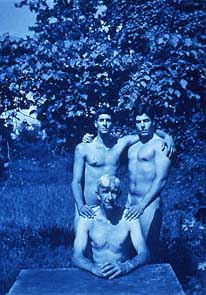
In the Curator’s
Statement, Sawdon Smith states:
"The purpose of searching through the archives was to
find self-portraits that spoke to me about life as an HIV-positive
person and how people had visualized their 'newfound' body.
In the end not all the images selected are self-portraits,
but I felt the few exceptions still reflect my interest in
how our identity and subjectivity may become altered, even
reinforced by a diagnosis of ill health.
"As a photographer
I was naturally drawn to this exhibition being about photography,
but also because of the relationship that the photograph,
as a reflection like the pool that Narcissus was drawn to,
has with our concept of self, the image we carry in our mind's
eye of who we are. Photography is not a pure reflection. It
is not unmediated. It provides us with a version of the world,
like that of Jacques Lacan's mirror stage analysis -- an infant's
mis-recognition of itself in reflection as a whole body while
its experience of the world is in a fragmented state, life
lived through representation."
The British photographer Richard Sawdon Smith is Director
of Studies at University College for the Creative Arts (UCA),
Farnham, England, Co-editor of the forthcoming AIDS Cultures
e-Journal, and a member of the Visual AIDS Archive Project.
He is currently researching an article on the effect of ill
health on self-image and subjectivity. His photographs and
writing are published in a number of books including; Cultures
of Exile (2004) Wendy Everett (ed); Art & Photography
(2004) David Campany; Male Bodies: A Photographic History
of the Nude (2004) & Fully Exposed: The Male Nude in Photography
(1990) both by Emmanuel Cooper; Vile Bodies: Photography and
the Crisis of Looking (1998) Chris Townsend and Representations
of HIV and AIDS: Visibility Blue/s (2000) Gabriele Griffin.
His work has been exhibited internationally including Galerie
Godante, Japan; Belem Cultural Centre, Portugal; La Calcografia
Nacional, Spain; MACBA (2002), and The Scottish National Portrait
Gallery, Scotland. Richard Sawdon Smith’s image is also
feature in Visual AIDS new World AIDS Day e-cards.
Founded
in 1988, Visual AIDS, strives to increase public awareness
of AIDS through the visual arts. The Frank Moore Archive Project
documents the work of artists with HIV/AIDS to ensure that
their artistic legacy will be preserved, thereby safeguarding
their place within art history. The Archive Project also facilitates
the creation and presentation of new work and provides practical
services to artists with HIV/AIDS, assisting in their pursuit
of a professional career. www.visualAIDS.org
The Body
is now the most frequently visited HIV/AIDS-related site on
the Web, according to the Medical Library Association and
also the most frequently visited disease-specific site on
the Web, according to <Hot 100>. The Body contains a
rich collection of information on topics ranging from HIV
prevention, state-of-the-art treatment issues, humor and art.
An invaluable resource, The Body is used by clinicians, patients
and the general public. Part of The Body's mission is to enable
artistic expression to reach the Web, and to join art with
other resources needed to help the public comprehend the enormity
and devastation of the AIDS pandemic and to experience its
human and spiritual dimensions. |