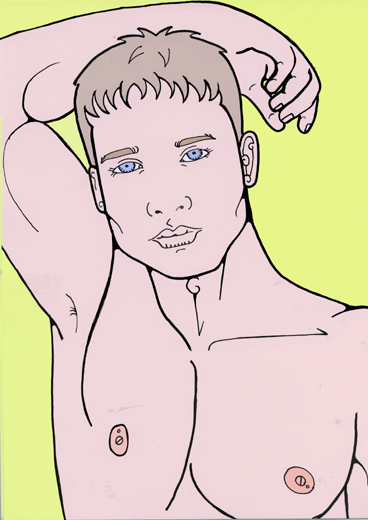
Mike Stead is an artist living and working in London. He
spent his childhood in various places like Germany, Hong Kong
and Thailand. This upbringing has given him unique vision
of the world which infuses into his work. His artwork has
compositional simplicity with a complicated sentimental narrative.
He invites the viewer on a journey to catharsis. The main
element of auto-biography gives the audience a voyeuristic
participation. He illustrates his psyche and emotions onto
the canvas with most of his characters being nude to amplify
the intimacy he wants with his audience. The images are natural
and naive but always passionate and beautiful.
His entire body of work is earnest, raw and revealing –
a view of the world coloured by experiences and daring the
viewer to relish the pain and the ecstasy, the challenges
and the daily triumphs. Mike is constantly working on his
portfolio as well as private commissions, including many portraits.
An exhibition of your work is
taking place at Adonis Art in August. What can we expect?
The bastard child of Tom of Finland and Roy
Lichtenstein is the only way to describe the experience.
Your work has a wonderful bold
simplicity that reminds me of Julian Opie. How would you describe
your style?
Julian Opie has been a big influence on my
work His “blur” album cover is iconic. My style
is bold, unapologetic, and simplistic with a sprinkle of campness.
Your figures all have perfect,
muscular bodies that have an almost cartoon like existence.
Is the pull between fantasy and reality of particular interest?
I’m trying to illustrate the pressure
that gay men are under to look perfect. There’s darkness
to the work. They may be beautiful but seldom do they look
happy. It’s the contrast between fantasy and reality
is fascinating to me.
Your work has a string auto biographical
element to it. Are you re-creating specific situations and
people in your life?
All my work is self referential. I think it’s
important for an artist to lay bare their life experiences
and be as honest as possible with their audience. If I can’t
see a part of myself in the work then I don’t feel it’s
a worth while piece and it will probably be discarded or painted
over. If I’m upset by someone then that situation will
be painted as with my “oppression” and “lies”
pieces. It’s a more productive way of expressing anger
than shouting. The same can be said if I’m happy. My
work can either be very cutting or a great compliment to the
people in my life.
You’ve said before that
your work gives its audience a voyeuristic participation and
the paintings have a very sellable, glossy and air brushed
look about them that are very seductive. Are you asking the
viewer to get emotionally and sexually involved?
I’m inviting the viewers to see me at
my beast and worst. I also want them to see themselves in
the work. I want to induce emotions that they may not like.
I also like the feeling of arousing my audience not only intellectually
but also sexually.
The paintings are highly erotic,
so what sort of guys do you prefer to paint?
I prefer to paint well defined unattainable
men. I tend to paint men that I wouldn’t dare approach
in a sexual context. By painting them I become intimate with
them without the fear of rejection.
And in real life, what kind of
guys do you go for?
Aesthetically I have to say I love Latin men…..It’s
the lips I think…..beautiful, like you could kiss them
forever. As for the personality they have to be honest, reliable,
and tender and most of all they have to see my worth beyond
what I look like.
So, how do you find your models?
Models seem to find me mostly. But if I need
to go looking for inspiration the internet is a good place
to start, Gaydar is a goldmine of beautiful men and a resource
I pillage weekly. If I see a beautiful photograph in a book
or magazine I will store it and use it a later date. They
usually only inspire a pose or mood but they are a priceless
starting point.
What is it about the naked male
body rather than a clothed one that you find so attractive
to paint?
I paint most of my characters nude because
I like the vulnerability. I want the work to be completely
about the subject and not confused by clothing. Most of the
work is about emotions and inner conflict. I want my audience
to be intimate with my subjects. I want no barriers between
the viewer and my message.
How does your sexuality influence
your work?
I paint from my perspective and I think that
my sexuality plays an undeniable role in my work. I paint
what I desire and find aesthetically pleasing.
Do you think it’s important
for the gay community to see itself represented in art?
I think all communities should be represented
in art. I think it’s the “art world’s”
responsibility to accept that our community have the right
to paint our world without it being demeaned as trivial pornography.
I think it’s important for our community to be represented
so our lifestyle can be finally recognised as valid in the
art world and not sniggered at. Art is about life and the
gay community is a large part of that.
What’s the biggest cliché
about gay art?
That it has no substance and all “gay”
art is about sex. This can be said of all “gay”
preconceptions. It’s hard for the straight world to
see that our community cares passionately about the same things
they do. We want love, we want to be accepted and we play
a priceless role in society.
Okay, so where do you stand on
the whole ‘gay art’ label. Is it a necessary genre
of art or redundant ghettoising of painting in general?
I think that society needs to label everything
in order to understand it. Sometimes I think that label can
be detrimental as it can restrict your audience and pigeon
hole you. Who says a heterosexual woman/man can’t enjoy
a painting of two men embracing? Its offensive, not only to
me but to art itself, to think that a label can reduce the
importance and audience of the work! My work is about life,
it just happens to be from a gay perspective.
You've been creating pictures
for quite a while now. How has gay art changed during this
time?
It amazes me when I look back at older work;
I wonder how I made the journey. The work has evolved from
being relatively heavy and clumsy. Initially I used heavy
brush strokes to demonstrate emotions. Now I rely more on
colour and line to express what I have to say. It’s
become simple yet more powerful. My Granny used to say “less
is more.” Which is true of so many things.
And finally, what are your plans
for the future?
Planning for the future is difficult for me.
I don’t know where I’ll be from one week to the
next. All I know is that I will be painting. It’s a
compulsion and addiction with me. I would like for my work
to be recognised as a valuable dialogue on life. I want to
be recognised as an artist who has important views and brings
a fresh perspective to my genre.
|