In the Curator’s
Statement:
1) Magical Stagesets
2) The Happening and the Importance of Style
Stardust is
inspired by a time, a place (mainly New York and London)
and a culture personified by David Bowie and the New York
Dolls. David Bowie and the New York Dolls experimented with
gender -- which was represented in a more fluid manner,
wearing non-mainstream "punk" fashions -- and,
of course, made great, inspiring music. The music and the
manner in which they represented themselves were wildly
creative, glamorous and spontaneous. The artists who I selected
for Stardust have an element in their work of the exhilaration
and the riotously creative energy of this music and time.
The artists selected
also relate to lyrics from songs, theatrics on stage or
by groupies, fashion from the time and the actual stage
itself where the music was performed. David Bowie may be
taking off any minute in his space ship to the stars and
the New York Dolls could be part of some other worldly vagabond
group of beautiful outsiders. Each artist in Stardust somehow
personifies the joy, the beauty and the music in some manner.
Stardust can
be grouped into a couple of smaller shows. The first grouping
of images is subtitled "Stardust: The Magical Stage"
and includes a blurry, drugged out color photo by John
Morrison of backstage at CBGB. Jimmy DeSana's
image of a floating, genderless body reminded me of Bowie
flying away into outer space. Sarawut Chutiwongpeti's
glittery installation of glowing lights and rows of columns
would be a perfect stage to perform on, as it captures the
other worldly nature of performance and ethos. David
Wojnarowicz's work is a detail of a larger installation
piece and, again, is a space for a mutinous performance
that is riotous, messy and ecstatic all at once.
The second grouping
of works is subtitled "Stardust: The Happening and
the Importance of Style." This group of artists was
either making work in NYC during that time or was actually
capturing the scene itself. Others share a sensibility with
the music, the style or energy of that time. A color photograph
of Grace Jones in white face paint and red hair talking
to Keith Haring by Juan Rivera and a photograph
of Keith Haring in the Pop Shop in the late 80s capture
the burst of creativity and intensity of the time. Works
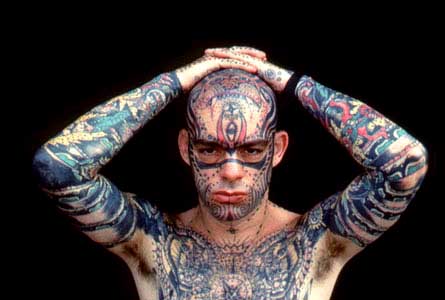
by Bern Boyle, Jose Luis Cortes
and Mark Morrisroe capture the punk stylishness
of the time with immense hair, numerous tattoos and men
who are both very masculine and very feminine at once. Images
by Derek Jackson ("Darrell: The Armory
Show," "First Timer"), Max Greenberg,
Hunter Reynolds and Albert Winn
are playful and sometimes melancholy depictions of individuals
at parties after the concert and perhaps behind the stage
flirting and being watched and desired. David Abbott,
John Morrison and Yolanda
capture glamorous individuals being playful and showing
rapturous aspects of the music, the scene and the time.
Bowie and the
Dolls, through their performances and music, made it seem
that anything and everything was possible. Even space travel
was possible and perhaps this represented a location where
one could occupy a different and more magical world. In
some manner, all the artists in Stardust depict this magic
and the creative energy of the time and the music.
b i o g r a p h
y
Leah
Oates is an artist and an independent curator living in New
York. Oates has a B.F.A. from the Rhode Island School of Design,
a Fulbright Fellowship for study in the United Kingdom and
an M.F.A. from the School of the Art Institute of Chicago.
Oates
recently curated "Dark Nature: Part 1 & 2" and
upcoming exhibitions include "Reconstruction," "States
of Longing" and "Locations of Elsewhere" at
Chashama Gallery in Time Square and Harlem. Oates has also
curated exhibitions and projects in New York with NURTUREart
Gallery, The Organization of Independent Artists, Artists
Space and The Kaufmann Arcade (a satellite space for A Taste
of Art Gallery); and curated exhibitions in Chicago at the
Peace Museum, Randolph Street Gallery, Woman Made Gallery
and Noyes Cultural Arts Center. Oates writes for NY Arts Magazine
and has written for AC: Collaborative, an online arts journal.
As
an artist, Oates has exhibited in over 80 group shows and
10 solo shows, both nationally and internationally. Her works
on paper and books are in the collections of the Brooklyn
Museum of Art, the National Museum of Women in the Arts, MoMA,
Franklin Furnace Archive, Yale University Art Library, the
Victoria and Albert Museum and the Tate Modern in London.
Founded
in 1988 by arts professionals as a response to the effects
of AIDS on the arts community and as a way of organizing artists,
arts institutions, and arts audiences towards direct action,
Visual AIDS has evolved into an arts organization with a two-pronged
mission: 1) Through the Frank Moore Archive Project, the largest
slide library of work by artists living with HIV and the estates
of artists who have died of AIDS, Visual AIDS historicizes
the contributions of visual artists with HIV while supporting
their ability to continue making art and furthering their
professional careers, 2) In collaboration with museums, galleries,
artists, schools, and AIDS service organizations, Visual AIDS
produces exhibitions, publications, and events utilizing visual
art to spread the message “AIDS IS NOT OVER.”
The Body
is now the most frequently visited HIV/AIDS-related site on
the Web, according to the Medical Library Association and
also the most frequently visited disease-specific site on
the Web, according to Hot 100. The Body contains a rich collection
of information on topics ranging from HIV prevention, state-of-the-art
treatment issues, humor and art. An invaluable resource, The
Body is used by clinicians, patients and the general public.
Part of The Body's mission is to enable artistic expression
to reach the Web, and to join art with other resources needed
to help the public comprehend the enormity and devastation
of the AIDS pandemic and to experience its human and spiritual
dimensions. |