In the Curator’s
Statement:
When approaching
the Visual AIDS slide library, I thought it best to approach
it with an idea in mind. This is a large archive and approaching
it with a more specific theme seemed reasonable to me. One
theme that I am strongly drawn to is portraiture. It is
a constant and very important focus of my own work, thus
choosing portraiture felt like a natural choice to me.
More specifically, I am attracted to images of masculinity
and male sexuality -- so I wanted to use this opportunity
to select a diverse group of portraits whose subject matter
was the representation of men.
The images I have selected are of men both young and old.
They are in many different stages in their life. Some are
looking at themselves through self-portraiture and others
are the object of someone elses eye. The experience that
I see that binds these disparate men is the thoughtfulness
of their gaze. There is a self-presentation amongst many
of them that conveys a relaxed "here I am" manner.
This for instance is seen in the body language of both Rob
Anderson's Norman Tyler Larson and Loreen Bryant's Mexican
Fervor.
These portraits elicit both a range of emotional responses
in me and a reading of the emotional state of the subjects
pictured. In some cases these feelings may overlap as my
attraction to some of the images manifests itself on a physical
level as with Vincent Cianni's portrait of the confident
adolescent Johnny posing shirtless with his birthday cake.
There is Robert Blanchon's beautiful, street-artist commissioned
charcoal self-portrait, which is both vibrant and dreamy.
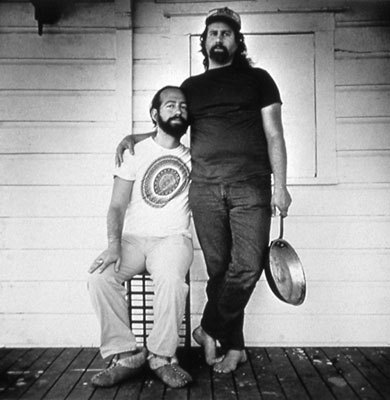
And George Towne's lovely and lanky Slava. I feel warmth
and camaraderie from Albert J. Winn's portrait of a couple
on a porch holding a frying pan, from his Radical Faerie
Series. I feel mild confrontation from Tara Popick's Untitled
elderly man holding onto railing, and I sense tension in
Tim McCarron's Luis who is grasping a chair.
The men portrayed in many of these portraits are not the
in-your-face, chiseled, lean-bodied or muscled bodybuilder
types that men are so often today bombarded with from advertising,
television and gay erotica. These men are a more subtle,
quiet and real-life, day-to-day image of maleness. And,
in the case of Frederick Weston's Richard XII, a more flamboyant
and celebratory version.
These portraits are all of individuals, and let us not
forget that the millions of victims and sufferers of HIV
and AIDS are individuals -- not statistics, nor political
tools, but once and now living, breathing human beings.
It is to them that I dedicate this web gallery.
b i o g r a p h y
Richard Renaldi is a photographer living in New York. He
has exhibited widely, including solo shows at Western Projects,
Calif.; Debs & Co., N.Y.; and an upcoming show at Yossi
Milo Gallery, N.Y., in January 2007. His work has also been
included in numerous group shows, including Strangers:
The First International Center of Photography Triennial of
Photography and Video, N.Y., and the traveling exhibition
Pandemic: Facing AIDS. Renaldi graduated from New
York University with a bachelor of fine arts in photography
in 1990. Richard Renaldi's first monograph, Figure and
Ground, was recently published by Aperture. Drawn from
a seven-year body of work, Figure and Ground is comprised
of portraits and landscapes taken from coast to coast, across
the United States. Together, they present a beautiful and
compelling look at America's increasingly diverse social landscape.
Renaldi has also devoted much of his photographic talents
to putting a living, human face on those afflicted with AIDS,
as well as its long-term survivors. More of his work can be
seen at www.renaldi.com.
Founded
in 1988 by arts professionals as a response to the effects
of AIDS on the arts community and as a way of organizing artists,
arts institutions, and arts audiences towards direct action,
Visual AIDS has evolved into an arts organization with a two-pronged
mission: 1) Through the Frank Moore Archive Project, the largest
slide library of work by artists living with HIV and the estates
of artists who have died of AIDS, Visual AIDS historicizes
the contributions of visual artists with HIV while supporting
their ability to continue making art and furthering their
professional careers, 2) In collaboration with museums, galleries,
artists, schools, and AIDS service organizations, Visual AIDS
produces exhibitions, publications, and events utilizing visual
art to spread the message “AIDS IS NOT OVER.”
The Body
is now the most frequently visited HIV/AIDS-related site on
the Web, according to the Medical Library Association and
also the most frequently visited disease-specific site on
the Web, according to Hot 100. The Body contains a rich collection
of information on topics ranging from HIV prevention, state-of-the-art
treatment issues, humor and art. An invaluable resource, The
Body is used by clinicians, patients and the general public.
Part of The Body's mission is to enable artistic expression
to reach the Web, and to join art with other resources needed
to help the public comprehend the enormity and devastation
of the AIDS pandemic and to experience its human and spiritual
dimensions. |