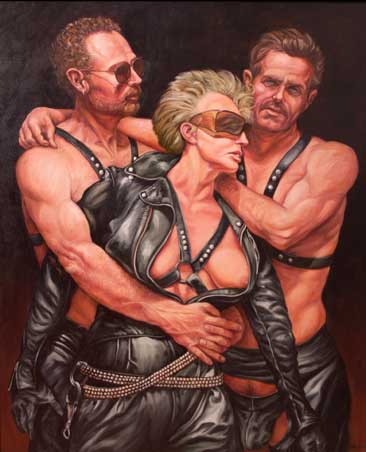
This series of paintings, Stations: A Gay Passion,
loosely references the biblical stations of the cross, but
is set on the “sex piers” of New York City in
the 1970s and early 1980s and depict the gay milieu of an
era long gone — but remembered as a mythic time of heroism
and theater of homosexual desire. The series of paintings
celebrate the male body at the height of “gay liberation”
and also memorializes the many gay men lost to AIDS as we
are reminded of the prejudice and ignorance still rampant
in our lives today.
Delmas Howe was born in 1935 in El Paso,
Texas and raised in Truth-Or-Consequences, New Mexico. He
graduated from Yale, served in the U.S. Air Force, studied
at New York’s Art Students League, and at the School
of Visual Arts. He has taught both privately and at the university
level and, for several years, had a successful career as a
muralist in New York City and in Amarillo, Texas.
Growing up in a place where cowboys were part and parcel of
daily life they remained a powerful influence. Particularly
so in a remarkable series of paintings from the mid-1970s
titled, A Panhandle Pantheon, in which the artist conflated
handsome cowboys, bronco busters, and sturdy ranchers with
the ancient Greek gods.
Although he had been emerging as an important artist for
some time, Howe gained far broader notice when the art critic
and writer, Edward Lucie-Smith, discovered his “cowboy”
painting, The Three Graces, at a 1978 exhibition at the Leslie/Lohman
Gallery in New York. The Three Graces eventually adorned the
cover of the British arts journal, Art and Artists (December
1979) and is now in the collection of the British Museum.
In 1993 Howe’s partner died of AIDS. Fleeing to Europe,
in a paroxysm of grief and rage, he haunted ancient churches
whose walls were covered with images of tortured male flesh.
But the church, where one should have been able to find comfort,
and the state, where one should have been able to find help,
simply declared a war of hate on Delmas and his kind.
Stations: A Gay Passion, is his response.
Since the time of the “Panhandle” series the
artist’s work has been seen in American and European
museums and is in numerous international collections. He is
also the recipient of several arts awards including, most
recently, the New Mexico Governor’s Award for the Arts.
Being unflinchingly true to himself, Delmas continues to
live his life in a maelstrom of controversy. Just one example:
a Howe painting had to be removed from a show in a Texas museum
because important donors threatened to terminate their support
if the work was not expunged from the exhibition. Undaunted,
Delmas has soldiered on producing ever more powerful works.
The critic Edward Lucie-Smith states that Howe, “belongs
to a new species of polemical avant- garde.” That is
most certainly true. But beyond that — Delmas is not
only a great artist, but also, for doing what he does, one
of our true heroes.
The Leslie/Lohman Gay Art Foundation,
established in 1990, is a nonprofit organization dedicated
to furthering the awareness and appreciation of GLBTQ art
that may not be exhibited due to prejudice and ignorance.
Since its inception the Foundation’s gallery has presented
over 200 exhibitions including hundreds of gay and lesbian
artists whose work represents the fundamental view that “gay
art” does exist and that the “gay/lesbian”
artist has contributed immeasurably to our visual culture
from prehistoric to ancient Greece to the contemporary era.
The Foundation has a considerable permanent
collection of art, including, Andy Warhol, Duncan Grant, Delmas
Howe, Jean Cocteau, Deni Ponty, Sonia Melara, Cassandra, Marsden
Hartley, Horst, Bastille, Blade, Tom of Finland, Michael Kirwan,
and many more.
|