| January 1 - 31, 2010 | Online |
Visual AIDS and The Body
present:
Light Itself
Curated by Joy Garnett
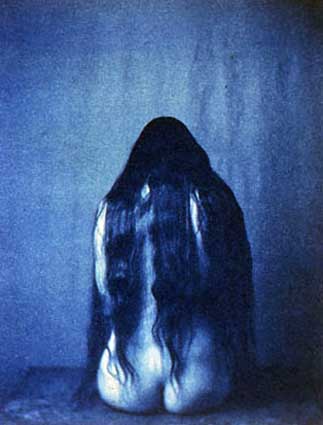
JOHN DUGDALE
Margie
1996, cyanotype, 10" x 8"This month, Joy Garnett curates the artwork of Archive Members; Stephen Andrews, Jimmy DeSana, John Dugdale, Per Eidspjed, Tony Feher, Felix Gonzalez-Torres, Peter Madero III, Chuck Nanny, David Nelson and David Wojnarowicz.
NOTE: Previous exhibitions are also available on the website.
In the Curator’s Statement:
I have been thinking a lot lately about what the mind does when it is denied information. Does it plant meanings in the empty spaces? And if so, where do these surrogate meanings come from? I have been thinking especially about gaps of information in images: the empty spaces, the answers withheld or encrypted. The lengths we go to, unknowingly, in supplying a narrative or a pattern where none is offered. We know that the brain supplies perpetual visual experience even in the absence of stimuli — visual input from within. The eye continuously wanders over life's glittering but impervious surfaces, seeking gratification — does it give up once it has been satisfied? And if it is denied what it expects, will the mind's eye supply the missing meanings in lieu of the forms and phrases that would otherwise meet our expectations?
Of course, in the realm of art, the intentional agitation of the gaps between viewer and object is a given. An initial absence will reveal itself at any moment as full-to-bursting presence. We hardly know it's happening. Tony Feher's dangling, half-empty bottles twirl gently in space, to suddenly catch gulps of light and become, magically, half-full, enacting a cognitive leap from detritus to the sublime before we even register it. On the other hand, light itself obscures our vision as we search for the outline of a form or for a way out. While blinding us, Stephen Andrews' searchlight only enhances our understanding of night; we see figures in a lifeboat, impossible to get to, about to slip back into the abyss. In the same breath, Jimmy DeSana's spectral self-portrait in negative exposes the artist as incorporeal; did he just nod and tip his hat before dissolving into a puff of pale smoke, like a vampire in sunlight?If seeing is possessing, this is especially frustrated here by the resolute back of a nude who wears her river of black hair like a veil in John Dugdale's Victorian inflected cyanotype, signaling seduction while denying our eyes access. Felix Gonzalez-Torres' Untitled (Last Letter) offers one small clue to desire deferred in the form of a jigsaw puzzle: a fragment of lovers' correspondence, otherwise lost and unknowable -- and yet all-too-well known.
In another twist, an intact human head is missing from David Wojnarowicz's cartoon corpse lying on the pebbled ground; a flare of transparent blood where the head once was offers a pattern, and through this absence emerges a presence that is strange and strangely more pleasing than the thought of crushed and ruined head. Chuck Nanney's Disappearance is a mask with a face — not a face behind a mask. How much of this mask does the face reveal: the entire cosmos it embodies? At the very least, a stormy horizon line and a monstrous attitude. One's direct line of sight is likewise confounded in Per Eidspjeld's RNA, a pinwheeling collage of disembodied limbs, where full corporeal bloom is delivered through grotesquely abbreviated encoding.
Pattern recognition gives way to an all-too-familiar non-recognition in the systemic, abstract intricacies of David Nelson's What I Was Seeing, obscuring our vision through constant agitation in a warm, psychedelic bath of light waves, while Peter Madero III's La Corona offers us nothing less than heaven itself, and all the release and redemption it holds, if one could only leap over the impossibly high loops of razor wire up into the luminous grey sky.
b i o g r a p h y
Joy Garnett is an artist who lives and works in New York. Her paintings, culled from news photographs, military documents and other images she gathers from the Internet, examine the apocalyptic sublime at the intersections of media, politics and culture.
Garnett is a 2004 recipient of a grant from Anonymous Was a Woman, and serves as Arts Editor for the scholarly journal Cultural Politics. She is represented by Winkleman Gallery, New York. For more information please visit her website.
Every month, Visual AIDS invites guest curators, drawn from both the arts and AIDS communities, to select several works from the Frank Moore Archive Project.
Founded in 1988 by arts professionals as a response to the effects of AIDS on the arts community and as a way of organizing artists, arts institutions, and arts audiences towards direct action, Visual AIDS has evolved into an arts organization with a two-pronged mission: 1) Through the Frank Moore Archive Project, the largest slide library of work by artists living with HIV and the estates of artists who have died of AIDS, Visual AIDS historicizes the contributions of visual artists with HIV while supporting their ability to continue making art and furthering their professional careers, 2) In collaboration with museums, galleries, artists, schools, and AIDS service organizations, Visual AIDS produces exhibitions, publications, and events utilizing visual art to spread the message “AIDS IS NOT OVER.”The Body is now the most frequently visited HIV/AIDS-related site on the Web, according to the Medical Library Association and also the most frequently visited disease-specific site on the Web, according to Hot 100. The Body contains a rich collection of information on topics ranging from HIV prevention, state-of-the-art treatment issues, humor and art. An invaluable resource, The Body is used by clinicians, patients and the general public. Part of The Body's mission is to enable artistic expression to reach the Web, and to join art with other resources needed to help the public comprehend the enormity and devastation of the AIDS pandemic and to experience its human and spiritual dimensions.
Visual AIDS
526 W. 26th St. # 510, New York, NY 10001
Phone: 212.627.9855 · Fax: 212.627.9815
e-mail: info@visualAIDS.org
Visual AIDS Gallery