| October 1 - 31, 2010 | Online |
Visual AIDS and The Body
present:
osc: obsessive sex collecting
Curated by Sarah Forbes
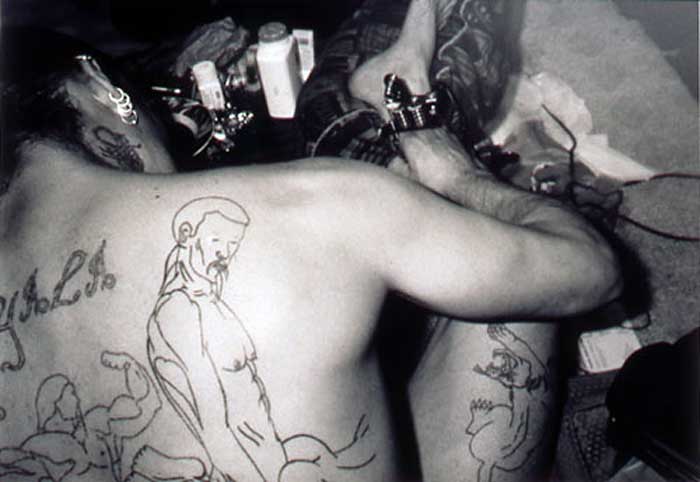
JOSE LUIS CORTES
Frankie's' Tattoos Series #2, 2001
G elatin silver print. 8" x 10"This month, Sarah Forbes curates the artwork of Archive Members; Barton Lidice Benes, Robert Blanchon, Curtis Carman, Jose Luis Cortes, Brent Nicholson Earle, Tony Feher, Frank Green, Michael Golden, Felix Gonzalez-Torres, Jerry Hooten, horea, Derek Jackson, Elliot Linwood, Gin Louie, Gregory Veney and Joel Wateres.
NOTE: Previous exhibitions are also available on the website.
In the Curator’s Statement:
The compulsion to collect can be related to a wide array of objects such as coins, marbles, figurines, newspapers and pieces of paper. Hoarding, the more extreme end of the collecting spectrum, has even become the focus of popular reality television shows, documenting how this compulsion can take over a person's life. At times this drive to collect can be directly tied to someone's sexuality and sexual identity.
While some cultural institutions briefly touch upon the theme of sex, the outright and unwavering inclusion of the topic is rare. By avoiding sex, a museum or gallery space can become a clinical and sanitized repository for a collection of works, but in this selection, the idea of the "collection" is charged through its association with sex.
Overtly sexual objects, erotic art pieces, a lover's hair or even sexual experiences can all be collected. Even the amassing of tattoos, both traditional and erotic, can be considered a process of collecting, as well as an analogous sexual experience, with someone giving and another receiving the art form.
In the recently released biography Secret Historian by Justin Spring, the life of Samuel Steward, a professor turned tattoo artist and gay pulp fiction author under the pseudonym of Phil Andros, is an extraordinary example of a sexual collector, who began his collecting in an era where these explicitly homosexual items could have easily had him arrested. Coaxed and supported by Alfred Kinsey, Steward kept detailed records of all of his sexual encounters. Graphic Polaroid photos of sex parties, and in some cases, clippings of his partner's pubic hair, were included in his "Stud File," a typed card catalogue documenting every partner and sex act he participated from 1924 to 1974.
Passing away in 1993 at the age of 84, Steward's "Stud File" included 746 cards, approximately 850 sexual partners and just shy of 5,000 individual sexual acts with another person, in addition to over 80 boxes of photographs, drawings and manuscripts.
Beyond the overtly sexual items found in collections, new meanings emerge when the implication of sex is tied to an object. A collection of pills, syringes, viles of blood and condoms is transformed when connected to sex in a post HIV/AIDS world. This selection of "collections" from the Visual AIDS archive is an exercise in perception for the viewer, curated with the unabashed implication of sex and sexuality.
b i o g r a p h y
A Native New Yorker, Sarah Forbes has worked with the Museum of Sex since 2004, and has served as the museum's sole curator since May of 2006. During her tenure at the Museum of Sex she has curated over eleven exhibitions, covering a variety of disciplines such as science, health, art, design, media, and technology. The New York Times described her most recent curatorial work with the exhibition Rubbers: the Life History and Struggle of the Condom, as "fascinating" and "extraordinary ... creat[ing] a modest exhibition that elevates the status of the condom." Rubber is currently on exhibition until December 5, 2010.
Aside from the New York Times, Sarah has been featured in a wide range of publications such as the New York Post, El Diario, Time Out New York, Art Daily, I-D, Print, Radar, Nylon, Sculpture, Associated Press, Wired, Reuters and New Scientist. She has also appeared on CBS, NBC, Bravo's Ironic Iconic America, Mike and Juliet, Montel, VH1 Brazil, Playboy Radio, Resto del Mundo and the documentaries Indie Sex, featured on IFC, as well as the new release Behind the Burly Q directed by Leslie Zemeckis. In addition to media attention, she speaks regularly at both academic conferences and universities. Sarah recently co-authored the article "Revealing Moments: Representations of Disability and Sexuality" based off of her curatorial work with the 2007 exhibition Intimate Encounters: Disability and Sexuality. The article was published in the 2010 Museum Studies textbook, Re-Presenting Disability: Activism and Agency in the Museum.
Sarah received an MA in Anthropology from the New School University and a BA in Anthropology from Connecticut College. Her research has primarily focused on gender issues in Latin America, primarily in Mexico and Venezuela.
Every month, Visual AIDS invites guest curators, drawn from both the arts and AIDS communities, to select several works from the Frank Moore Archive Project.
Founded in 1988 by arts professionals as a response to the effects of AIDS on the arts community and as a way of organizing artists, arts institutions, and arts audiences towards direct action, Visual AIDS has evolved into an arts organization with a two-pronged mission: 1) Through the Frank Moore Archive Project, the largest slide library of work by artists living with HIV and the estates of artists who have died of AIDS, Visual AIDS historicizes the contributions of visual artists with HIV while supporting their ability to continue making art and furthering their professional careers, 2) In collaboration with museums, galleries, artists, schools, and AIDS service organizations, Visual AIDS produces exhibitions, publications, and events utilizing visual art to spread the message “AIDS IS NOT OVER.”The Body is now the most frequently visited HIV/AIDS-related site on the Web, according to the Medical Library Association and also the most frequently visited disease-specific site on the Web, according to Hot 100. The Body contains a rich collection of information on topics ranging from HIV prevention, state-of-the-art treatment issues, humor and art. An invaluable resource, The Body is used by clinicians, patients and the general public. Part of The Body's mission is to enable artistic expression to reach the Web, and to join art with other resources needed to help the public comprehend the enormity and devastation of the AIDS pandemic and to experience its human and spiritual dimensions.
Visual AIDS
526 W. 26th St. # 510, New York, NY 10001
Phone: 212.627.9855 · Fax: 212.627.9815
e-mail: info@visualAIDS.org
Visual AIDS Gallery